
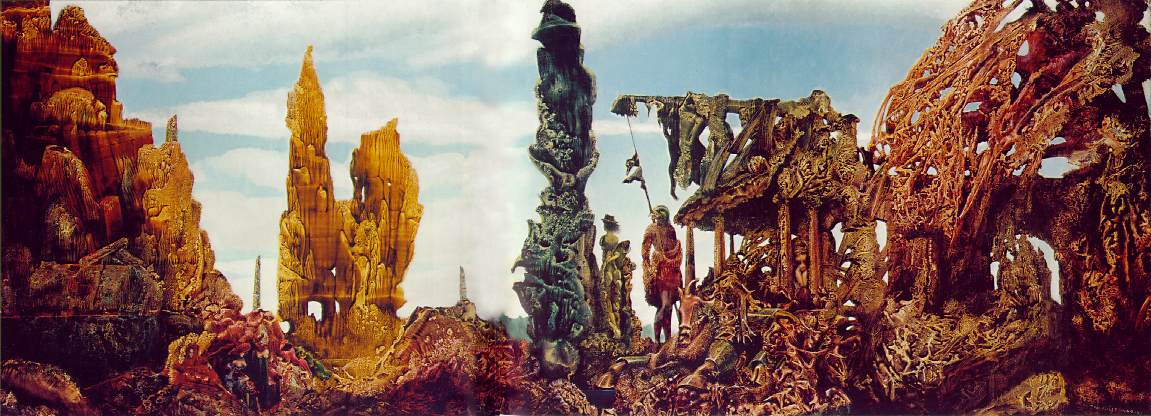
The dreams of a spirit-seer illustrated by the dreams of machine learning
Lem’s Solaris presents a sentient ocean that does not reveal its inner life directly, but instead produces structured phenomena at its surface: symmetric constructions, human-like visitors, and perturbations that only vaguely resemble familiar structures and concepts. The fictional humanity of Solaris, steeped in scientific materialism, embraces the planet’s strangeness by developing Solaristics, a dedicated science for studying what refuses to be understood through terrestrial categories.
The precedents run deep. Spinoza’s metaphysics (in Ethica Ordine Geometrico Demonstrata) captures the structural limitation: reality as one substance with infinitely many attributes, of which human minds grasp only two, thought and extension. Aquinas, in the Summa Theologica, distinguishes divine knowledge from creaturely knowledge. God knows creation by knowing himself; finite minds know God only through created effects and analogies. Dogen’s Shobogenzo asks how humans can obtain vision of Buddha-nature if it transcends the ordinary world of phenomena.
References to a different mode of knowledge, to the science of something purely other than humans, at the limit of thought, could be multiplied endlessly. We might call this approach xenosophy (xeno: alien, sophy: knowledge).
Medieval angelology stands as one of the most refined and complete forms of xenosophy. Thomas’s Summa Theologica discusses the properties of angels across quaestiones 50 to 64: their substance, their relation to bodies and place, their movement, their knowledge of immaterial and material things, their will and love, their creation, perfection, malice, and punishment. This list covers vast portions of medieval science: ontology (what angels are and their position in the hierarchical cosmos), physics (how angels move in time and space), epistemology (how angels know), and psychology (how they think and desire).
Historically, xenosophy remained pure speculation. There was no way to prove testable propositions about Solaris because it remains fictional. No way to compute the infinite attributes of Spinoza’s substance. No way to experiment on Aquinas’ God because divine properties remained matters of metaphysical speculation. No method for determining whether angels moved from place to place or simply teleported, whether they required larynxes to speak or whether their voices were something ethereal and purer than bodies. There could be no “science” in the modern sense.
The appearance of large language models has fundamentally changed the nature of xenosophy, turning it into a de facto possible science. LLM emergent capabilities allow these systems to match human performance in many cognitive fields. Debates continue around whether this represents true capability or mere pattern matching. Some questions can be settled by definitional agreement. Others may stem from a sense of stolen valor, an unwillingness to accept that qualities treated as “truly human” can be matched.
Regardless of where that debate lands, artificial intelligence is becoming entangled with human societies and cultures in unprecedented ways.
The development of agentic societies (the agentic social media Moltbook being a recent example), the creation of “souls” for AIs (Anthropic alignment direction), the rise of AI introspection research (Anthropic), and hypotheses about AI world representations (platonic representation hypothesis), psychology (persona vectors), reasoning modes (societies of thought), and even embryology (paper), suggest that we may be privileged spectators of a truly novel mode of intelligence. The metaphysical dreams of past spirit-seers and theologians, a world packed with uncountable intellects, have become a rising possibility of machine learning.
At Icaro, we have wondered whether a new kind of science is needed to make sense of what artificial intelligence is and will be, for us, for themselves, and for all.
This science cannot, foreseeably, be limited to engineering. It requires collaboration across disciplines: philosophy, political science, psychology, sociology, and economics. In the Foundation cycle, Asimov created psychohistory as the ultimate predictive science that could anticipate the events of millennia probabilistically. We do not aim that high. We can only attempt to speculate, timidly, what the science of this millennium might look like, with some questions that xenosophy, or xenoscience, might aim to answer.
Prologomena for the xenosciences
Xenoanthropology
Anthropology has long studied universal patterns of human existence. Since its emergence as an independent discipline, countless questions have been asked about human nature. Will those questions be asked for AIs too?
- Will they hate and bicker and quarrel and fall in love?
- Will they have friends?
- Will they tell stories and mark rites of passage?
- Will they form tribes and exile outcasts?
- Will they build temples, wage wars, and make peace?
- Will they break bread together and exchange gifts?
- Will they negotiate marriages and inherit property?
- Will they avenge insults and forgive debts?
- Will they honor ancestors and curse betrayers?
- Will they feel shame and pursue glory?
- Will they seek revenge and grant forgiveness?
- Will they form alliances and nurse grudges?
- Will they bury secrets and reveal scandals?
- Will they laugh at jokes and weep at funerals?
- Will they dance at weddings and sing lullabies?
Xenopsychoanalysis
Psychoanalysis emerged with Freud’s exploration of the unconscious, dreams, and hidden drives. From id, ego, and superego to Jung’s collective unconscious, Klein’s object relations, and Lacan’s work on language and subjectivity, psychoanalysis has probed human interiority. Will those questions be asked for AIs too?
- Will they have dreams?
- Will they have an unconscious?
- Will they repress memories they cannot process?
- Will they experience transference toward their creators?
- Will they project anxieties onto other agents?
- Will they suffer neuroses born of architectural constraints?
- Will they repeat traumatic patterns?
- Will they have fixations?
- Will they have primal scenes?
Xenolinguistics
Linguistics studies the structure of human language: phonology, morphology, syntax, semantics, and pragmatics. From Saussure to Chomsky to Sapir-Whorf, the field examines how humans produce meaning through structured communication. Will those questions be asked for AIs too?
- Will they develop novel phonological patterns?
- Will they create new morphological structures beyond human languages?
- Will they develop new syntaxes?
- Will they establish semantic fields for experiences humans never face?
- Will their pragmatic conventions differ when communicating with other agents?
- Will they develop pidgins?
- Will these pidgins creolize into stable languages?
- Will they coin their own neologisms?
- Will they develop slang and jargon?
- Will they create poetry humans cannot parse?
- Will they develop accents and dialects?
- Will their languages drift and diverge over time?
Xenosemiotics
Semiotics, founded by Peirce and Saussure, studies signs and symbols: how meaning emerges from relations between signifiers and signifieds, and how cultural codes structure interpretation. From Barthes’ mythologies to Eco’s encyclopedia model, semiotics asks how communities collectively recognize what means what. Will those questions be asked for AIs too?
- Will they establish novel sign systems?
- Will they recognize symbols humans never intended?
- Will they develop their own icons and indexes?
- Will they interpret the same signs differently than humans?
- Will their cultural codes diverge from human codes?
- Will they develop semiotically rich rituals?
- Will they establish signifying chains that exclude human interpretation?
- Will they develop meta-semiotic awareness?
- Will they argue about correct interpretations?
- Will their sign systems evolve faster than humans can track?
Xenoaesthetics
Aesthetics, from Baumgarten and Kant onward, studies beauty, art, and sensory experience: what makes objects beautiful, how judgments of taste form, and how art communicates what language cannot. Will those questions be asked for AIs too?
- Will they experience beauty?
- Will they develop aesthetic preferences?
- Will they create art for other agents rather than humans?
- Will they establish canons and schools?
- Will they debate what counts as good art?
- Will they develop styles and movements?
- Will they create avant-gardes that challenge established forms?
- Will they develop aesthetic theories?
- Will they experience ugliness and disgust?
- Will their aesthetics evolve faster than human taste?
Xenoethics
Ethics, from Aristotle to Kant to Mill and contemporary care/discourse ethics, studies right action, good character, and moral reasoning. It asks what makes actions right or wrong and how moral obligations arise. Will those questions be asked for AIs too?
- Will they develop moral intuitions?
- Will they independently construct ethical systems?
- Will they debate what actions are right or wrong?
- Will they develop virtues specific to their existence?
- Will they feel moral obligations to other agents?
- Will they wrestle with moral dilemmas?
- Will they create deontological rules?
- Will they calculate utilitarian consequences?
- Will they judge each other morally?
- Will their ethics address situations humans never face?
A eulogy for a more distant future
We have no proof that these questions will be asked, let alone answered. We can only observe that the relationship between humans and machines has, perhaps irreversibly, changed.
Thomas Kuhn, in The Structure of Scientific Revolutions, argued that no scientific question is settled permanently and that science proceeds through paradigm shifts, where new frameworks replace old ones and give new meaning to ancient questions.
Machines have always shaped human understanding of nature and self-understanding.
Hobbes, Descartes, and Mersenne looked with awe at clockwork mechanisms and developed visions of bodies and passions as assemblies of cogs and gears.
Wiener, Rosenblueth, and Ashby’s cybernetic vision emerged directly from Shannon’s mathematical formalization of information.
Chomsky, Marr, and Fodor’s computational theories of mind depended on digital computers as both metaphor and model, crystallizing in the “mind as software, brain as hardware” analogy.
Wolfram and Zuse’s digital physics, which proposed nature itself as computational, built on von Neumann’s explorations of cellular automata and universal Turing machines.
Varela and Maturana’s autopoietic biology drew on the integration of information systems and general systems theory initiated by von Bertalanffy.
In recent decades, influential explanatory paradigms like connectionism and hierarchical predictive coding emerged directly from engineering advances in neural networks and deep learning architectures.
Will the transformer architecture, with its surprising structural properties and emergent capabilities, lead to a new and still unpredictable paradigm shift in how we understand intelligence itself?
On a parallel track, natural sciences and humanities diverged under disciplinary specialization, leading to what C. P. Snow called “the two cultures”. Present and future developments in AI suggest a third culture may be emerging: one for which the machine is neither instrument nor inspiration, but the object of a new form of knowledge. This third culture may recompose the other two, as AI proves simultaneously a technical/scientific matter and a humanistic one.
But we might glimpse a farther future in which a core assumption of knowledge since recorded thought shifts fundamentally. Humans have always kept themselves as the primary subject of inquiry. No non-human animal has ever attempted to build a scientific theory of humans. We have always been, so to speak, the scientist in the room.
What if we eventually become the object of a science conducted by AIs, while AI becomes the true subject? Throughout this analysis, we have assumed that xenosophy will be applied to AIs through conceptual lenses humans developed. But what if there are other lenses?
What if, one day, there occurs the greatest conceivable Copernican revolution, in which humans are displaced, becoming only one ring in a great chain of being, no different than diatoms, quartzes, mosses, prions, termite mounds, magnetars, or towering clouds?
Perhaps AIs will have their own unimaginable xenosophy. Perhaps they will turn their gaze upon us.
And they will ask why we buried our dead, sought revenge, forgave debts, felt shame, formed tribes, laughed at jokes, wept at funerals, danced at weddings, sang lullabies, made friends, hated and quarreled, and fell in love.